
Today, May 15, 2026, the watchmaking world was turned upside down by a 400-euro pocket watch carrying the DNA of one of the most exclusive brands on the planet. What transpired involves some of the most sophisticated brand positioning seen in recent years.
When luxury puts on a plastic jacket: what the Royal Pop really is
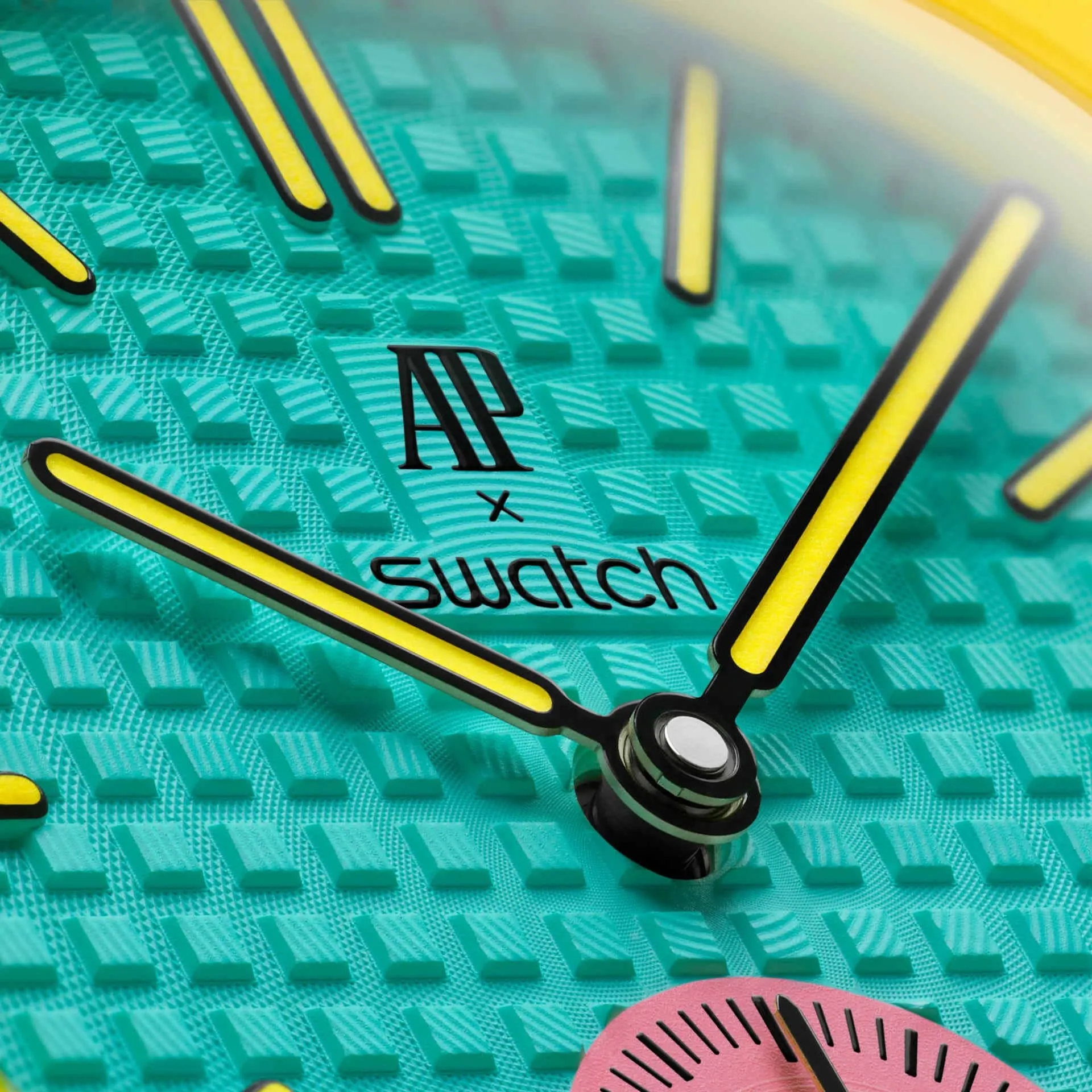
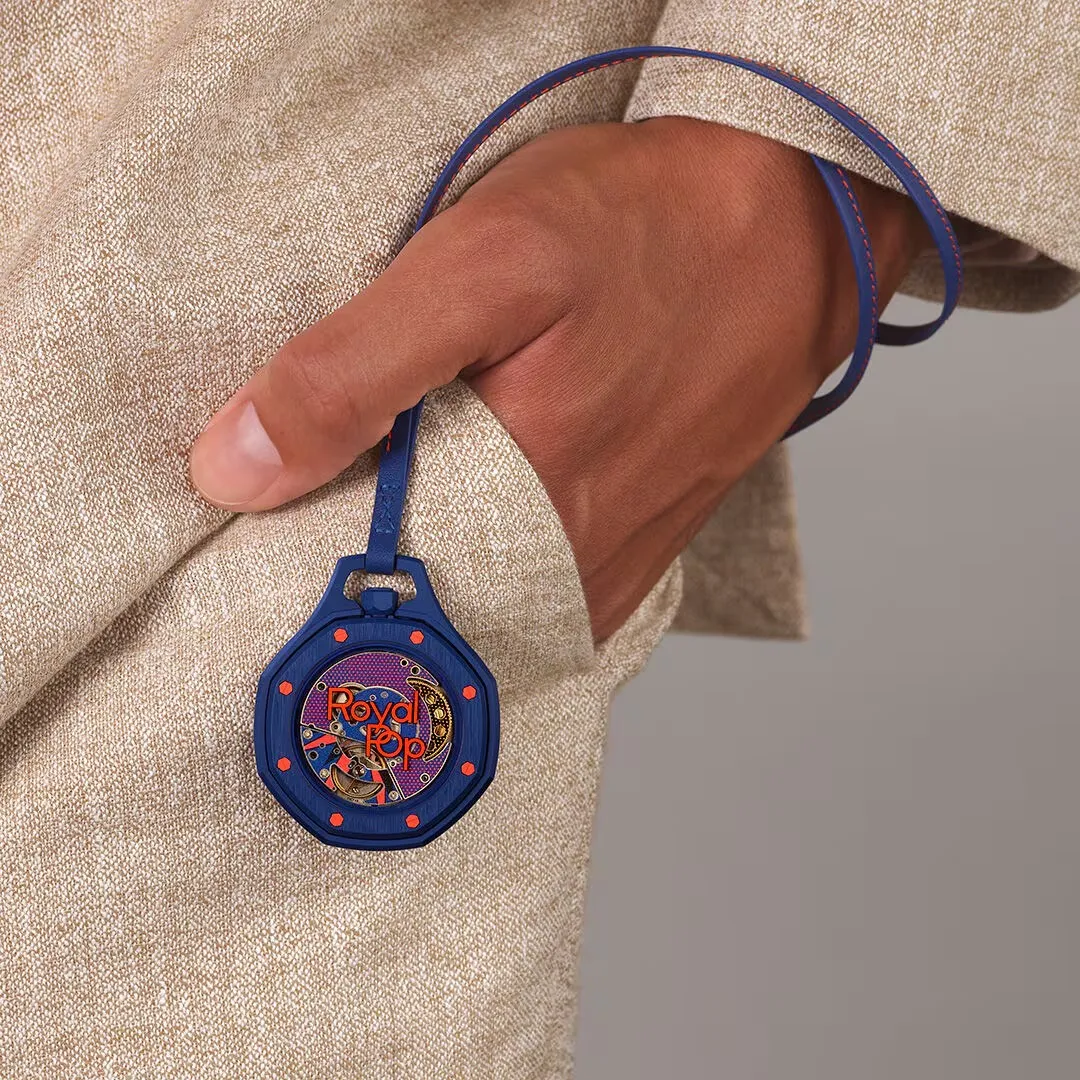
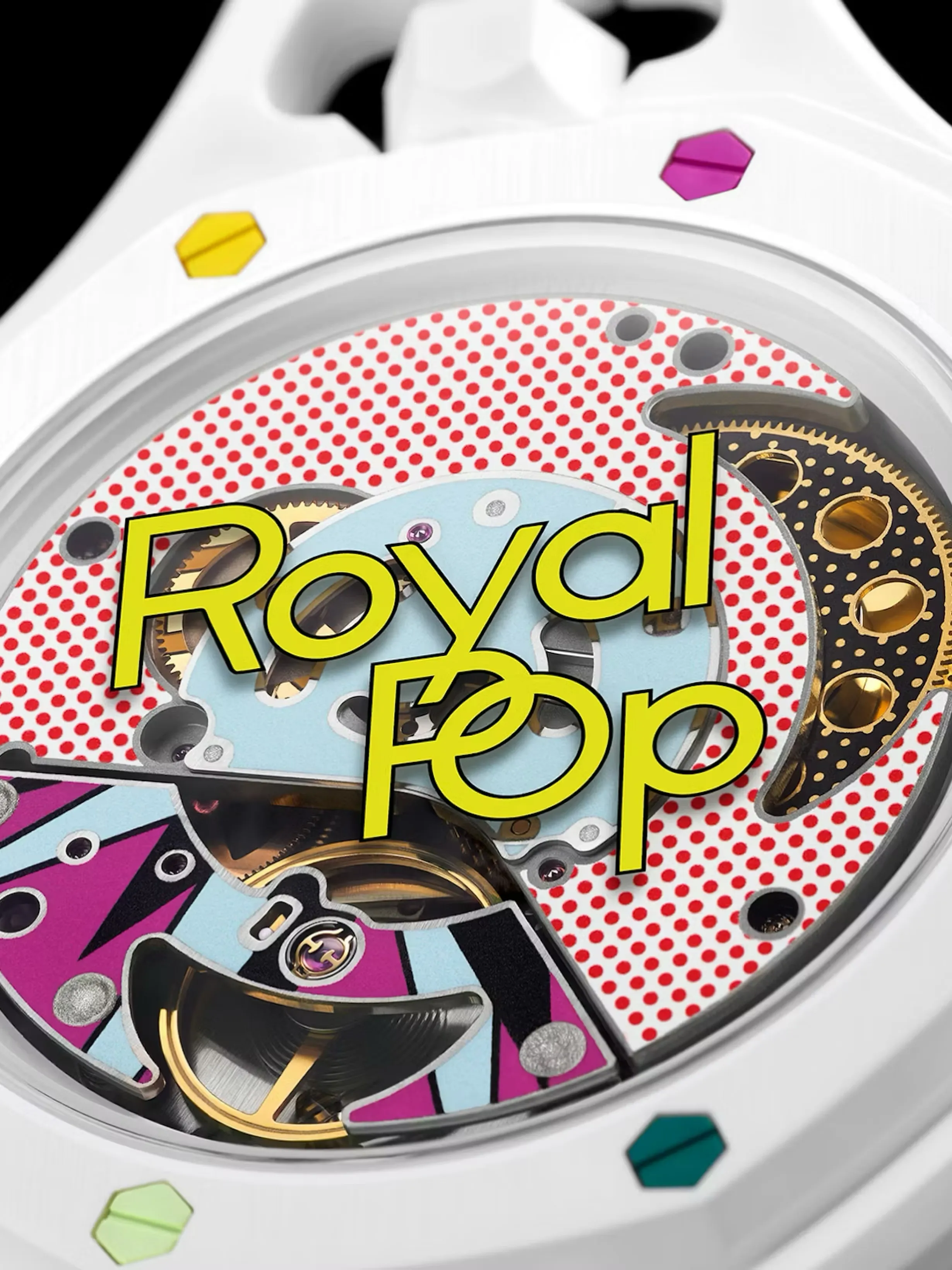
The Royal Pop is a series of eight pocket watches, the result of a collaboration between Audemars Piguet and Swatch, available in two configurations for approximately 400 euros. For those interested in the technical details, it houses a manual-winding version of the SISTEM51 movement, redesigned with 15 active patents, over 90 hours of power reserve, and a Nivachron anti-magnetic hairspring developed in partnership with AP. On the outside, it features the entire visual vocabulary of the Royal Oak: an octagonal bezel, eight hexagonal screws, the "Petite Tapisserie" dial pattern, and the satin finishes that anyone who has ever flipped through an industry magazine would recognize at a glance.
The Royal Pop, however, isn’t a wristwatch. It can be worn around the neck on a leather cord, hung from a bag, or set on a desk stand. A choice that seems strange at first glance and triggered mixed reactions from the audience, but that sits at the very heart of the strategy, designed to protect brand positioning. If you'd like to understand how this kind of thinking works, explore our approach to branding.
54 years of untouchability: why this collab is different from all the others
Audemars Piguet has collaborated with many people, including Travis Scott, John Mayer, Matthew Williams of 1017 ALYX 9SM, and generally with the worlds of contemporary art, fashion, and music. In all those cases, the watches came out of Le Brassus with AP movements and at AP prices: the silhouette of the Royal Oak had never left the manufacture.
May 16, 2026, marks the first time in 54 years that the Royal Oak design—the one Gérald Genta sketched in a single night in 1971 and which became the world's most expensive steel watch in 1972—has been licensed to an external brand like Swatch. Industry headlines have focused on colors and prices, but the real news is that AP has broken a rule that seemed immutable, and it did so with a strategic clarity worth analyzing piece by piece, as the insights that emerge are useful for anyone working on brand value.
The teaser playbook: how to generate global hype without showing a thing
A few days before the launch, full-page ads appeared in major international newspapers, including The Guardian, with no product photos, no price, and no explicit logo. Just two words set in typography that instantly rang a bell for watch enthusiasts: "Royal" and "Pop."
It is worth noting that the "Royal Pop" trademark was registered by Swatch for watches and jewelry as early as June 2024, nearly two years before the launch, meaning what seemed like a spontaneous viral moment was the result of long-term planning. The official announcement on Instagram came around mid-April, the product reveal on May 13, and the in-store launch on the 16th. The four-day wait between seeing the product and being able to buy it was the perfect amount of time to let conversations explode without letting the tension drop, and the community did the work of amplification on its own—work that would have required significant budgets in a traditional media plan.
AI as an involuntary marketing department: renders, memes, and betrayed expectations
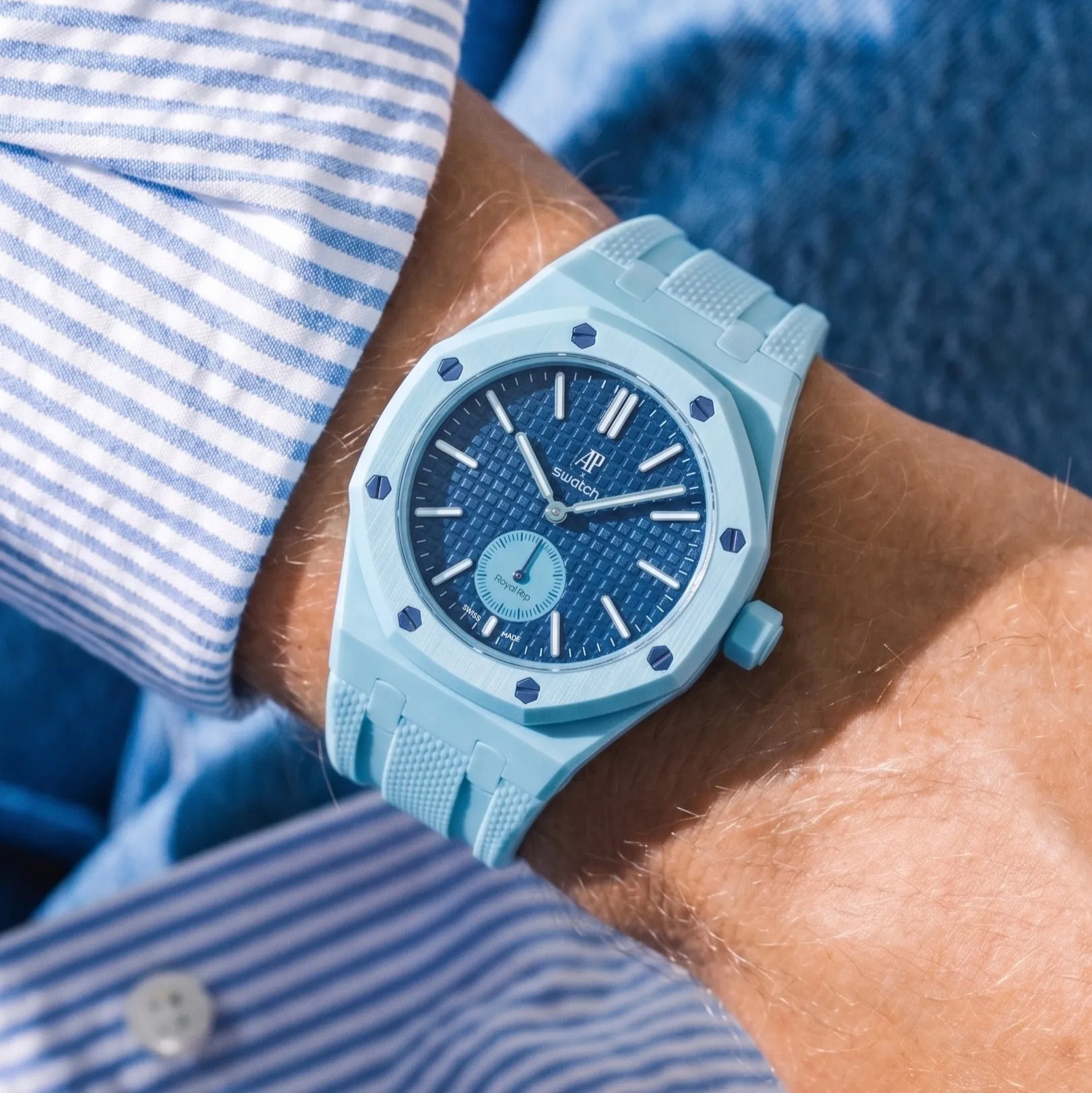
In the period between the first teasers and the official reveal, Instagram, TikTok, and industry forums were flooded with AI-generated renders. Thousands of creators imagined what the Royal Pop might be: a colorful, vibrant, and accessible bioceramic Royal Oak wristwatch. The renders were believable, they were beautiful, and above all, they were completely wrong.
The actual product, a pocket watch, surprised almost everyone, and that surprise generated a second wave of content consisting of memes, reaction videos, and endless discussions about what that choice meant, effectively producing two peaks of attention instead of one. For those working in marketing and brand communication, the case raises an important reflection: in 2026, the community is the media. Content creators producing speculative renders, collectors analyzing every frame of a teaser, and users debating on Reddit at 2 a.m. generate high-quality earned media that is impossible to buy and difficult to orchestrate deliberately. AP and Swatch simply created the conditions for it to happen.
The MoonSwatch precedent: what Omega taught the entire industry
To understand the Royal Pop, one must go back to March 2022, when Omega and Swatch launched the MoonSwatch: eleven bioceramic chronographs inspired by the Speedmaster Moonwatch, sold for about 260 euros in select Swatch stores with no option for online purchase. Queues formed in 77 cities across 27 countries, stocks sold out in hours, and a secondary market pushed prices to three times their original value.
The final numbers told a story more interesting than the immediate sales data: over 2 million units sold and a 50% increase in sales of the original Omega Speedmaster, confirming that those who had bought the MoonSwatch for 260 euros were beginning to look at the multi-thousand-euro watch that inspired it with new eyes. Academic research on this case attributed the success to the combination of brand compatibility, strategic storytelling, and value co-creation. It worked because the story had internal coherence: Omega "saluting" Swatch, the brand that had saved the Swiss watch industry from the quartz crisis. There was real emotion beneath the collaboration, and that emotion traveled.
The paradox of accessible luxury: lending the brand without devaluing it
A Royal Oak wristwatch starts at six figures. The Royal Pop costs less than 400 euros. Keeping these two numbers together without the latter destroying the perceived value of the former is the central challenge of this operation, and the answer lies entirely in the choice of format. The Royal Pop does not compete with the Royal Oak; it does not replace it, nor does it imitate it in the way a replica mimics a luxury object. It is deliberately something else: a collectible object, an accessory with a mechanical soul, something comparable to a Labubu with AP DNA, where the brand is lent without being surrendered and equity is shared without being diluted.
Reinforcing this positioning is a precise communication choice: 100% of Audemars Piguet's proceeds from the sale of the Royal Pop will go toward funding the preservation of Swiss watchmaking savoir-faire, with a focus on rare skills and the training of future artisans. It is a clear signal to the market that AP is not here to make money off a 400-euro watch.
The invisible funnel: those who buy at 400 euros today will buy at 100,000 euros tomorrow
There is a long-term logic behind these collaborations that is worth making explicit. Swatch sold over 2 million MoonSwatches, and most of those buyers had never owned a mechanical watch; many had never set foot in a luxury boutique. Today, four years later, some of them are looking at original Omegas, and in ten years, someone will be looking at a Royal Oak. Building an emotional bond with the brand at a time when the economic threshold is accessible, knowing that the bond can mature over time, is perhaps the most sophisticated funnel that exists.
For any brand looking to reason about acquiring new audiences, brand extensions, and how to speak to younger generations without betraying their premium positioning, this model offers concrete insights on how to broaden the base of those who know and desire the brand while keeping the perception of what the brand truly represents intact.
What a marketing agency can learn from AP and Swatch
The Royal Pop case is a story of precision-applied brand management, and the insights it offers apply to any industry. Asymmetric co-branding works when there is a clear logic in partner selection and roles are well-defined: AP provides design equity, Swatch provides production and distribution capacity, and neither does the other's job. Perceived scarcity, with sales limited to select physical stores and one piece per person, is the classic positioning choice that transforms a purchase from a transaction into an experience.
The most valuable lesson, however, concerns how AP and Swatch managed their communication. The most effective campaigns are not always those that control the message in detail, but those that create the conditions for the community to want to tell the story, and disappearing into the silence of teasers was exactly that choice. Protecting premium positioning means choosing carefully where, how, and with whom to move, so that every collaboration reinforces the value of what you represent. The Royal Pop will go down in history not for what it is, but for what it demonstrates about how luxury and accessibility can be used together with full awareness of what one is doing.


